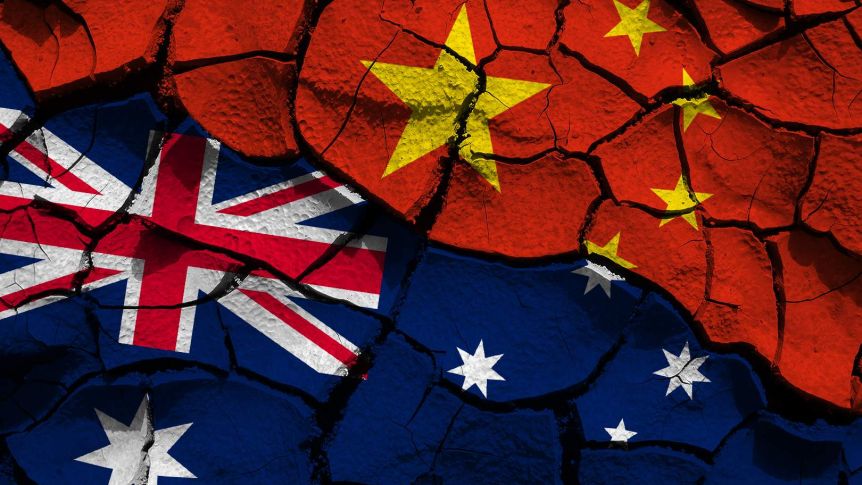
The relationship between China and Australia has admittedly seen better days. The once ‘economic strategic partnership’ does not bear the same narrative. China is Australia’s most substantial trading partner; China accounts for 39.4% of exported goods and 17.6% of services exports carried out during 2019 and 2020. Due to the unprecedented pandemic, Australia’s economy is at risk of contracting by 2.8%.
Australia and China formerly developed relations in 1972 after switching acknowledgement from Taiwan. Since the establishment of a relation between the two nations, their ties flourished economically, however, even in the 1990’s the friction between the two nations was implicitly present. The then Australian Prime Minister, John Howard, got off to a doubtful start with Beijing after cancelling an import financing program of which China was the one of the focal beneficiaries. Instead, Howard opted to meet with the Dalai Lama and to the surprise of many, this did not infringe the relationship between China and Australia after face-to-face exchanges.
Due to the lack of hindrance after Howard and Zemin’s encounter, observers opted to label the relationship between the two nations as the ‘economic strategic partnership’ – founded on practicality and mutual benefit. Thus, China became Australia’s number one trading partner and accounts for 39% of their exports as well as 27% of their imports (from 2019 – 2020) by the Australian Bureau of Statistics.

However, when did the cracks begin to show? In 2011, a few years after Howard had left office, Julia Gillard had taken over; Australia had become increasingly more vocal about the policies which Beijing had implemented alleging them to be aggressive and, in many ways, unnecessary. In response to this, Australia obstructed several Chinese investments based on national security in the past few years
Due to the spread and emergence of the coronavirus, Australia is one of several economies to have been negatively affected by the pandemic. It’s predicted that if the current trade war does not result in a form of resolution, Australia could be looking at a 6% decrease of GDP at the hands of a trade war with China. The economic recovery of Australia post-pandemic is already seemingly a point of concern; they have plunged into a recession for the first time in 30 years due to the virus. Back in 2008, Australia was the only major economy to have avoided any substantial damage to their economy and this was ultimately down to the relationship with China and the demand for natural resources exported from Australia.
As for the present-day analysis regarding the relationship between Australia and China, it is evident that Australia is largely dependent on China and its economic dependence. Economic analysts note that Australia may need to look towards other nation-states for economic reliance and more specifically other Asian nation-states. Having acknowledged that, analysts do not doubt the difficulty in being able to find a comparable replacement for China.
The trade wars between the nation-states are notably not likely to see a desirable ending. The contribution of the media’s narratives, as well as policy disagreements, could elongate a conflict resolution at this stage. Arguably, a resolution is very possible to be reached.

Conclusively, it is evident as to how the friction between the nation-states have emerged and some of the reasons behind the continuity have been acknowledged. Australia is seemingly heavily reliant on China for the importing and exporting of goods, having accounted for 38% of their exports and 27% of their imports which consequently puts China in the position of being Australia’s number one trading partner. Notably, the economic reliance on China is reiterated due to the economic effect the pandemic has had on Australia, leading them to a recession for the first time in 30 years as well as the potential 6% decrease in GDP as a result of the ongoing trade wars. Ultimately, there is room for resolution and a resurgence of an ‘economic strategic partnership’.
To keep up to date with the latest commercial news, click on commercial to get your daily dose
Donate & Support