By Ulvi Hagverdi
Your commercial awareness dose
Three decades-long conflict between Armenia and Azerbaijan over the occupied region of Nagorno-Karabakh is one of the longest-lasting disputes in the world. The conflict commenced in 1988 following Karabakh Armenians claiming the region to be transferred from Soviet Azerbaijan to Soviet Armenia. At the time, there were nearly more than 100,000 Armenians in Nagorno Karabakh (capital of Karabakh) and a million Azerbaijanis in Karabakh, including adjacent towns.
The conflict turned out to be a full-scale war that resulted in Armenian forces entering the region in the absence of formal Azerbaijani military forces following the Soviets’ collapse. Although ceasefire was signed in 1994, the actual conciliation between the parties is yet to be made. Majority-Turkish populated Azerbaijan is strongly supported by Turkey, while Armenia is a part of the Putin-led Collective Security Treaty Organization that justifies a potential Russian military intervention in case of a military threat.
From the legal aspect, the Organization for Security and Co-Operation in Europe requested both sides to impose an embargo on arm deliveries to forces participating in the combat in 1992. The most essential and internationally binding provision came in 2008 – the UN General Assembly reaffirmed the region as Azerbaijan’s territorial integrity and demanded withdrawal of the Armenian forces from Karabakh.
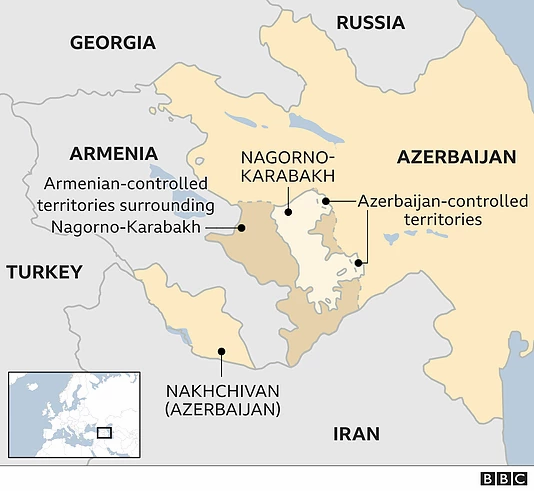
Having set out this historical path, a very intriguing question arises. Which economic and geopolitical implications that can this obscure conflict between 2 developing East European countries have on giants, such as the EU, Russia and Turkey?
The EU
Geographically, the region is of profound importance as a corridor for European energy supplies due to via gas and oil pipeline running through Azerbaijan, Georgia, Turkey and subsequently Europe. Interestingly, the latest tensions escalated right before Azerbaijan was preparing to pipe gas to the European Union, while these pipelines run within just 15 kilometres of its border with Armenia.
The South Caucasus pipeline, which has been build following attracting significant funds from US investors and British giant BP, delivers nearly 9.2 billion cubic meters of gas to Turkey and the EU. The gas deliveries to Greece and Italy from Azerbaijan is also about to start. These flows will initially constitute 3% of the EU’s gas imports, which is expected to rise afterwards.
Nevertheless, economists are most likely to highlight the risk to BTC (Baku-Tbilisi-Ceyhan) as the most significant. The project pumps a million barrels of Azerbaijani, Turkmenistani and Kazakhstani oil in total to the West daily. Although the project only constitutes 1% of the global oil supply, for now, it is regarded as an ideal opportunity for the West to cease its dependence on the Middle Eastern nations. Oil giants, such as BP (UK), Chevron (US) and Statoil (Norway) are the main shareholders of this $4 billion dollar project, which is also the second-longest oil pipeline in the post-Soviet region. According to Bloomberg, global oil demand in the upcoming quarter will be 7.1 % lower than the previous year.
Russia
With its wide history in the Caucasus, Russia possesses incredible power to bring an end to the conflict. However, Max Seddon from FT claims that as Moscow has established strong co-operation on defence, energy and trade with Turkey, the nation avoids coming vis-à-vis with its strategic partner in the Caucasus.
The Putin administration has already faced a great deal of international pressure due to poisoning of Russian opposition leader Navalny and siding with Lukashenko against democratic protests in Belarus. Given the significant economic sanctions imposed on Russia by the EU after the invasion of Crimea, Putin is cautious about entering the third front in Eastern Europe. The country’s economy is already significantly impacted by the halt of global oil demand while failing to come to mutual terms with Saudi Arabia as two OPEC countries make its economic climate even more slippery.

Turkey Turkey’s widely discussed President Erdogan has recently stated the importance of ending the occupation of the Karabakh. Although Armenian side had accused Turkish administration to assist their “brother-state” by deploying troops in the region, the international community is yet to be presented comprehensive evidence. Bobby Ghosh comments that Erdogan has already burned his bridges with the US and EU and has a “weaker hand” with its political strategy. The country’s economy has struggled immensely particularly following the pandemic trauma, which led the local currency lira’s tumbling to record lows against the dollar. The losses from the halt of travel industry and foreign investment leaving its economy, raises Karabakh conflict to a quite crucial level for Turkey.
The ongoing success of BTC pipelines, together with Azerbaijani and Central Asian governments pumping gas to the EU through Turkey will convert Turkey and Anatolia into an indispensable vital energy corridor for the world. And Erdogan is well aware of this and desires to capitalise this control into an economic advantage by solving the conflict. To sum up, any further escalation of the military tension between Armenia and Azerbaijan has potential of disrupting the EU’s energy supply. Nevertheless, closer cooperation between the EU and Eastern Europe can be witnessed in case of the conflict coming to an end.
Donate & Support