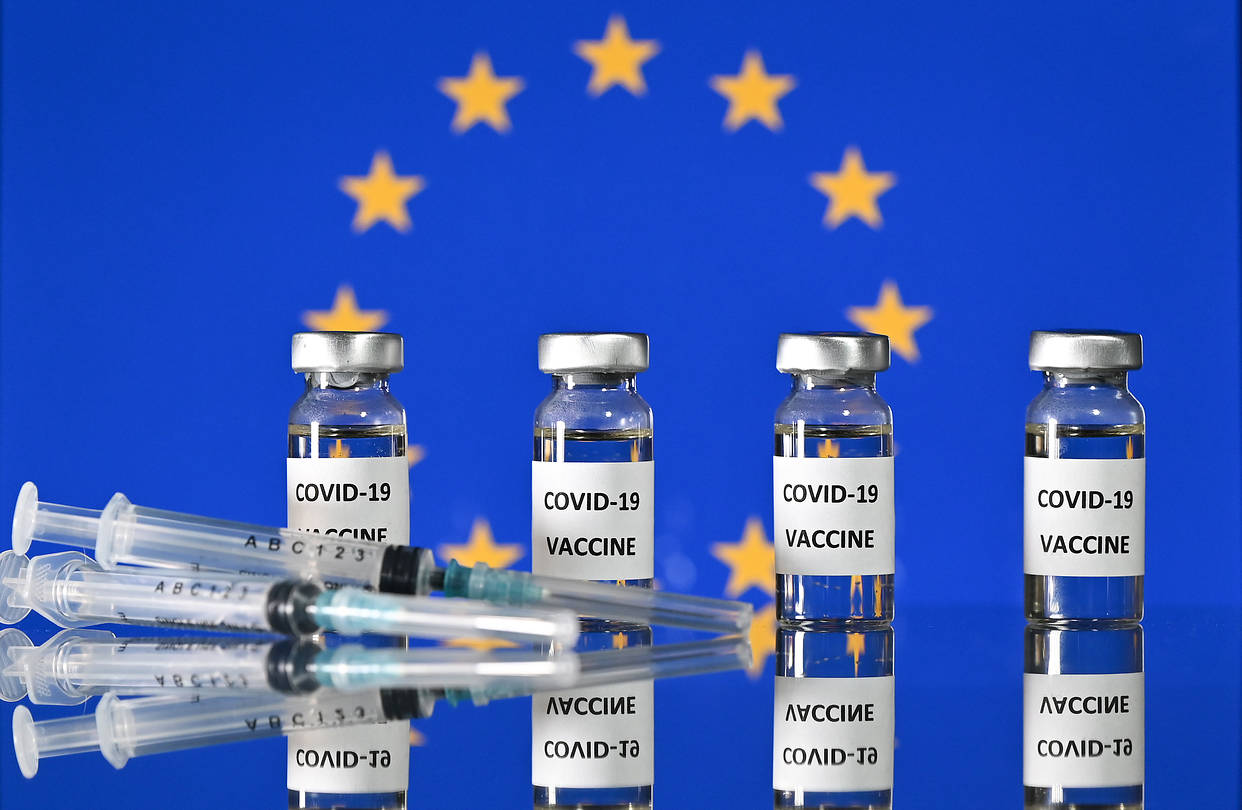
The Italian government halts a shipment of AstraZeneca vaccines to Australia and applies, for the first time, the regulation put in place by the European Commission following the supply crisis at AstraZeneca, which has announced that it will deliver half of what was planned in the first quarter of the year and remains to be seen whether it will meet its commitments for the second quarter.
If AstraZeneca doesn’t have vaccines for the EU, it doesn’t have them for anyone else. This reasoning, which has become a protectionist mechanism to prevent the leakage of vaccines manufactured within the EU to other corners of the world, has just made its debut in Italy. The laboratory has announced to the European Commission that it will deliver half of its commitment in the first quarter of the year – 40 million doses, instead of the 80 million signed up for, or 120 million at best.
Shipment blocked by Italy
Italy has blocked a shipment of AstraZeneca vaccines to Australia, according to the Financial Times. Italy’s newly arrived prime minister, Mario Draghi, who last week was particularly belligerent against vaccine suppliers, has for the first time applied the system devised at the end of January. At the time the European Commission dismissed it as a mere export ban system. And, in fact, for the entire month of February, it was not implemented.
But on Thursday, reports the Ansa news agency, the Italian authorities notified the European Commission of a decision to block the export of a batch of vaccines after receiving an application for authorization to export vaccines from AstraZeneca. The application was made following the European Commission regulation adopted on 30 January, “which makes the export of certain products conditional on the presentation of an export authorization”.
Thus, Italy has sent the non-authorization proposal to the European Commission: The Member State must decide on the authorization request “following the opinion of the European Commission”.
The Italian proposal to refuse authorization has been favored by the European Commission, and as a result, the Ministry of Foreign Affairs formally issued the measure to refuse the export of more than 250,000 doses.
Adopted under the emergency procedure, Brussels decided at the end of January that until the end of March 2021, exports of COVID-19 vaccines outside the EU will be subject to export authorizations. This regime only applies to exports by companies with which the European Union has concluded advance purchase agreements, such as AstraZeneca.
The fear of Italian government and EU
The fear of the Italian government and the European Commission itself is that AstraZeneca will not comply in the second quarter either. Indeed, last week an EU source quoted by Reuters said that between April and June AstraZeneca will deliver 90 million doses in the EU, half of the 180 million agreed. In total, AstraZeneca’s total supply to the EU could be around 130 million doses by the end of June, far short of the 300 million it committed to deliver by that date.
Right now, AstraZeneca is working to increase productivity in its EU supply chain and make use of its global network to deliver 180 million doses to the EU in the second quarter.

“What is important for us is that, together with the Member States, we can ensure rapid deliveries of sufficient quantities of doses,” a spokesperson for the EU executive explained: “The Commission and the Member States are in contact with the company, and we are working to achieve this.
EU takes steps
On Thursday, the EU took the first step towards authorization of the Russian vaccine Sputnik V. The European Medicines Agency (EMA) announced that it had authorized the vaccine. This was announced by the European Medicines Agency (EMA), which has started the preliminary analysis of the vaccine developed by the Russian epidemiology center Gamaleya. Whenever the European Commission has been asked about this, it has replied that an almost essential step for a pooled purchasing agreement is that it be produced in a plant within the European Union, which is currently not the case.
“The fact that the EMA authorizes the vaccine does not oblige the European Commission to conclude a preferential pooled purchase agreement,” said Eric Mamer, spokesman for the EU executive on Thursday: “When the time comes, if the Commission and the Member States decide to negotiate a contract with the manufacturers of Sputnik V, we will communicate it. We are in negotiations with Novavax or Valneva, we have signed a new agreement with Pfizer to accelerate the delivery of vaccines, but not with the manufacturers of Sputnik. This is the situation at the moment.
This announcement comes days after the EMA announced that it expects to give its recommendation for Janssen’s (Johnson&Johnson) COVID-19 vaccine on 11 March 2021. The European Commission will then give conditional marketing authorization.

The fourth vaccine
The Janssen/Johnson&Johnson vaccine will thus become the fourth vaccine, after BioNTech/Pfizer, Moderna, and AstraZeneca, to be made available in the European Union.
The European Commission has signed contracts with AstraZeneca (400 million doses), Sanofi-GSK (300 million doses), Johnson & Johnson (400 million doses), BioNTech-Pfizer (up to 600 million doses, although 500 million doses have already been confirmed), CureVac (405 million doses) and Moderna (160 million doses plus another 300 reconfirmed on Tuesday).
In addition, the EU executive is in exploratory talks with the pharmaceutical company Novavax for up to 200 million doses and with Valneva for up to 60 million doses.
To keep up with the latest commercial news, click on commercial to get your daily dose.
Donate & Support