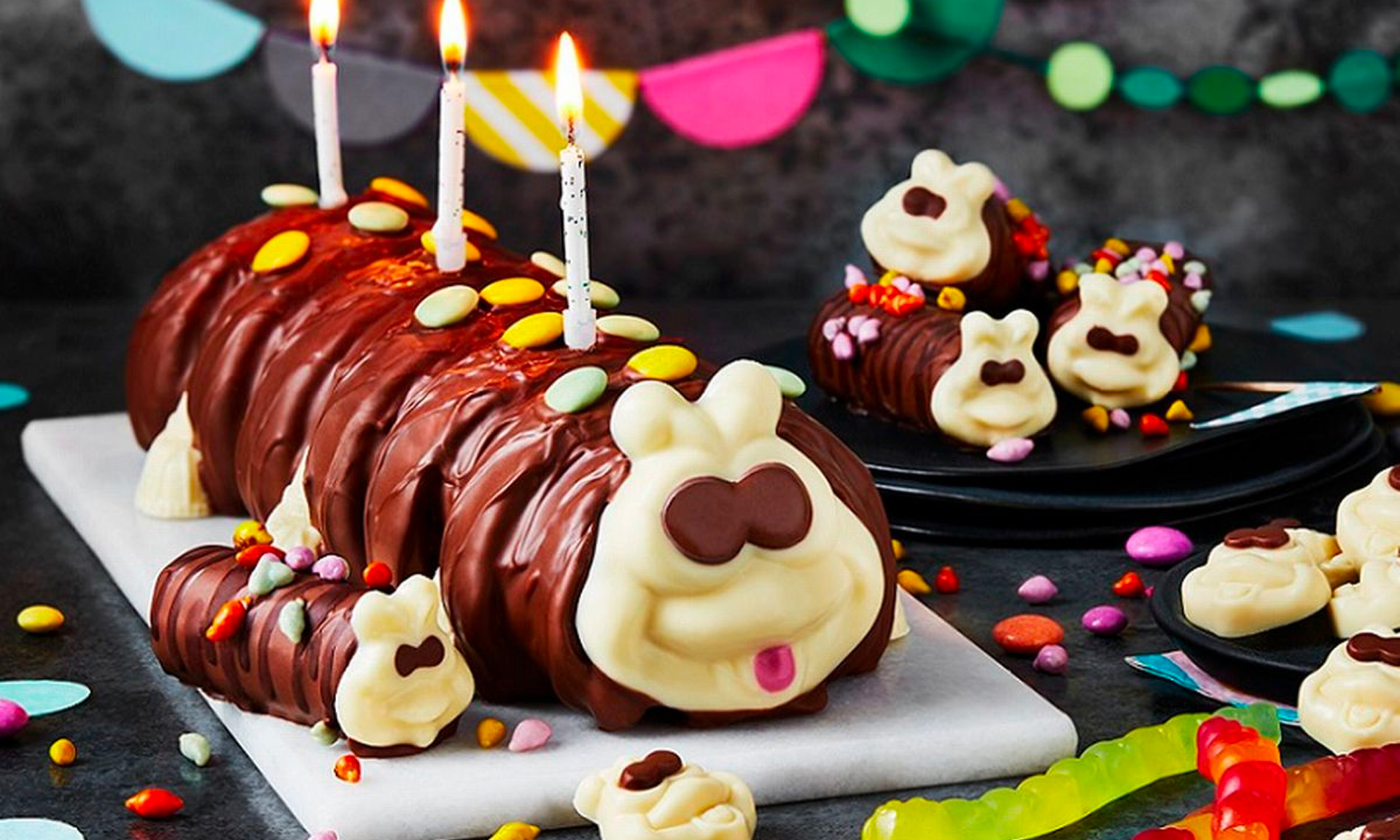
Anyone who shops in the UK will be familiar with a certain caterpillar shaped birthday cake. Colin the Caterpillar is Marks & Spencer’s iconic design, and it seems like its competitor Aldi may be in some trouble for its not-so-subtle copy of the M&S product, naming their version “Cuthbert the Caterpillar”.
Caterpillars in Court
Marks & Spencer has now taken legal action against Aldi concerning the similarities in the appearances of the two cakes. M&S is claiming that the similarity leads to consumers believing the two cakes meet the same standards. M&S are concerned that Aldi will, therefore “ride on the coat-tails” of the M&S reputation.
As M&S lodged an intellectual property claim on trademark infringement with the High Court over the last week, it has become clear that the claimant wants Aldi to remove the product from sale and agree to halt the sale of anything similar in the future. The action is set to protect three trademarks of M&S’s birthday cake product, which include the supermarkets’ variations of the design.
The basis of the claim lies in the fact that the appearance, branding and packaging of Aldi’s product are so similar to that of the M&S product that consumers are confusing the two items. Also, Aldi’s cake is sold at a reduced price of £5, while M&S’s cake costs £7.
Long Live Colin
The first version of M&S’s Colin was launched around 30 years ago. The overall appearance of the product has not changed since 2004. The product has since become a staple of the M&S brand and so, by taking legal action, the company hopes to protect their “reputation for freshness, quality, innovation and value”. The cake is a sponge with milk chocolate and buttercream with its hallmark appearance comprising of chocolate sweet toppings and a smiling white chocolate face.
Colin is a part of M&S’s partnership with the Macmillan cancer charity and funds collected from the product’s sale go into fundraising. Though M&S was the first retailer to sell a caterpillar cake, the design has since become a popular design among other British supermarkets including Waitrose’s Cecil, Sainsbury’s Wiggles, Tesco’s Curly, and Asda’s Clyde the Caterpillar.
Aldi’s Response
Despite the seriousness of being faced with legal action, Aldi has shown a real sense of humour, choosing to publicly make fun of M&S and their allegations. They started by mocking M&S’s famous slogan on its social media accounts. On Twitter, the budget supermarket wrote: “This is not just any court case, this is…#FreeCuthbert” and later tweeted “Just Colin our lawyers. #FreeCuthbert”. The supermarket has since posted various satirical TikTok videos, more tweets and other social media posts.
Opinions on the Future
As previously mentioned, one of M&S’s arguments will likely be based on the fact that consumers could be confused as to the origin of Aldi’s “Cuthbert Caterpillar”, and wrongly assume that the cake originates from M&S. However, legally this may not be a strong enough argument. The aforementioned are the numerous cakes that use the word “caterpillar” to describe to consumers the type of cake that is for sale.

This indicates that the problem lies with M&S itself as legally, elements within signs that are descriptive (“Caterpillar” describing the appearance of the product) are not able to be perceived as a trademark. The legal element here is that certain words need to be kept free for all traders to use in the marketplace to avoid a monopoly over the word in any context.
Where a logo contains a descriptive word, in the case the word is “caterpillar”, consumers look to other brand elements to differentiate the origin of the cake. Here, consumers may look to the name of the caterpillar: Colin”, “Connie”, “Wiggles”, “Clyde”, “Morris” or “Cuthbert”. Therefore, the Court may compare “Colin” and “Cuthbert” and conclude whether or not the differences between the prefixes and the dominant and distinctive elements would cause consumer confusion.
As there are other caterpillar cakes in the market, the High Court may find that the average consumer is aware that there are different traders of similar cakes and would not necessarily associate M&S with every one of them.
M&S could claim that Aldi’s cake amounts to ‘passing off. This is a common-law offence in the UK that can protect any goodwill associated with unregistered rights, including the ‘get up’ or appearance of a product. To be successful, M&S would need to prove that Aldi’s caterpillar damaged or has the potential to damage, their goodwill in Colin the Caterpillar – for example, through loss of sales if customers opt for Aldi’s cheaper alternative.
Aldi was previously taken to court by the makers of Moroccanoil who claimed that the similar packaging of Aldi’s Miracle Oil hair product to their own amounted to passing off. The claim was unsuccessful as the court found that the £26 price difference between to two products would allow consumers to avoid confusion. It will be interesting to see if the High Court reached that same decision as the price difference between the two cakes is not as large.
Anyone interested in IP and IP law should keep an eye out for the progress of this case. The findings of the Court will likely clarify many trademarks and passing off questions. It will also be interesting to see if Aldi’s response to the claims will play a part in the outcome of the case.
Aldi has used social media to reach its consumer base and create a “campaign” and “rivalry” of sorts between the customers of the two supermarkets. Keep an eye on whether the Court chooses to mention this and the effects of social media use and public voices have on such matters.
To keep up with the latest commercial news, click on commercial to get your daily dose.
Donate & Support