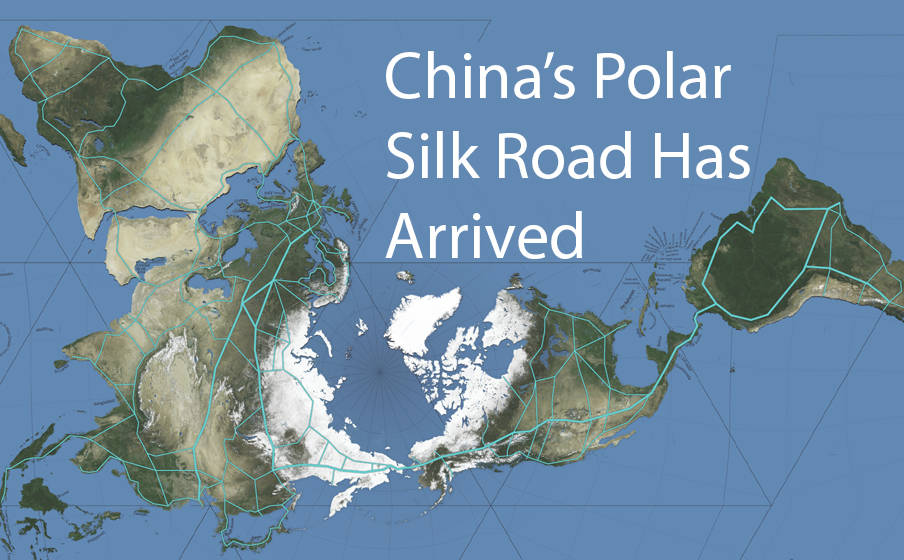
In its new 2021-2025 five-year plan, China has announced commitments to construct a “Polar Silk Road”, that would connect China with Europe. The route would be starting from Dalian and would cover the whole Pacific Ocean to the Arctic Ocean to meet Rotterdam in the Netherlands. The plan prioritizes active China’s participation in the development of Arctic and Antarctic regions.
Having built the road, China would hugely benefit from new shipping roots and consequent trade expansion. However, behind the rush is also another hope. As the global temperature rises and ice melts, in a few decades or sooner the region can be used for fossil fuel exploration and extraction. And for such a highly dependent on various oil, gas, and mineral resources economy, this is a vital opportunity.
Origins of the initiative
Back in 2018, China’s State Council Information Office made an official release of the country’s first Arctic White Paper. The document was originally released in both, Mandarin and English, introducing China’s position clear for the domestic as well as the foreign audiences.
Reasoning as a “near-Arctic state”, the White Paper justifies China’s interest and a potential role in the region. As an analysis suggests, China’s interests in the Arctic can be narrowed down to two categories.
On the one hand, China is involved in scientific research, resource exploration and exploitation, shipping, security, and other activities. On the other hand, climate change and its consequences are expected to affect the whole world, and China is not an exception. Therefore, being rightfully concerned in the Arctic affairs, China proposed incorporating the Arctic into its “Belt and Road” Initiative by encouraging joint efforts to construct the “Polar Silk Road”.
China has made quite clear its position and intentions in the White paper as well as giving public speeches afterward. Firstly, China promises not to “overstep” its role as a non-Arctic state and not intervene in the “domestic” affairs of Arctic nations. Secondly, China insists on being “absent” and underlines a strong desire to participate in cross-regional and global issues concerning the Arctic. It also became an observer member of the Arctic Council back in 2013.
Trade between China and Europe
Being tailored to connect Asia with Europe, the polar Silk Road initiative suggests the importance of the route for China-to-Europe. Indeed, for European countries, both exports to and imports from China have been gradually increasing since 2009 up to date. According to Eurostat, the main European trading partner as of December 2019 was China, accounting for €363 billion in imports. In 2020, export amounted to €202.5 billion while imports increased by 5.6% up to €383.5 billion.
Interestingly, the overall picture of European trade in 2020 is quite aggravating, first of all, due to the pandemic. The trade relations dropped dramatically with the rest of the world: down 9.4% YoY in terms of exports, and down 11.6% YoY in terms of imports.

It is important to note that the Chinese overall exports rose 3.6% in 2020 despite the pandemic; in fact, it’s the only major economy with positive trade growth. The Polar Silk Road project is beneficial for Chinese trade, as it would reduce distances for global trade between Europe and Asia.
While the Polar Silk Road could significantly benefit the global trade relations in terms of decreasing the distance, it remains frozen for most of the year. Even if it will change over time, in perspective “here and now” the route is hard to traverse and more challenging than the other two Arctic shipping routes currently available, the Northern Sea Route and the Northwest Passage. However, the expansion is perceived to have strategic purposes rather than tactical utilization.
To keep up with the latest commercial news, click on commercial to get your daily dose.
Donate & Support