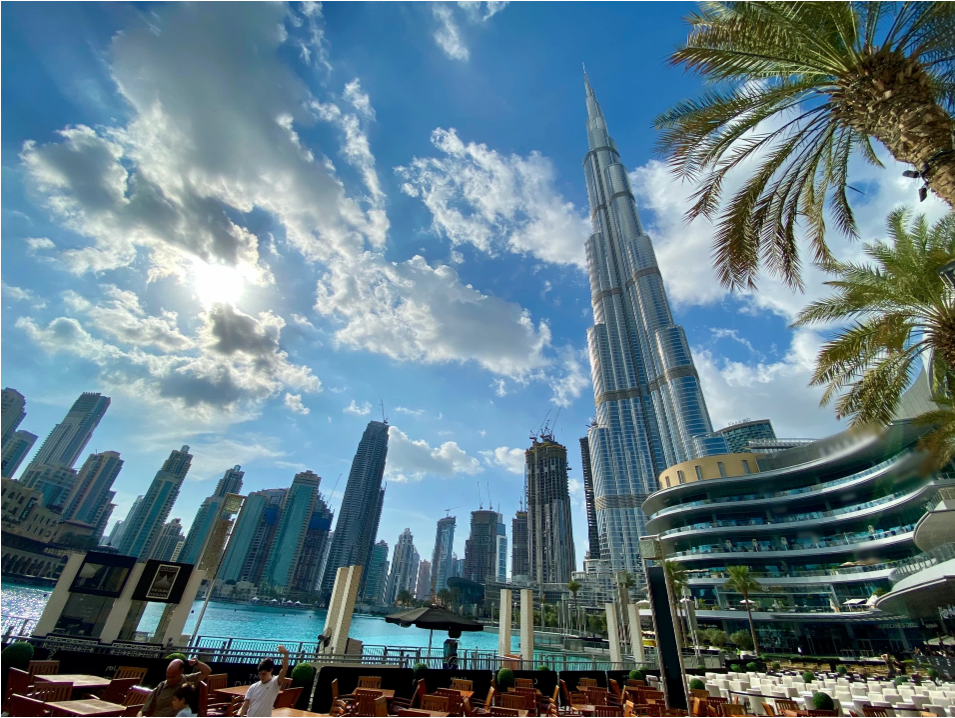
The UAE (United Arab Emirates), also known as the Emirates, is a country in Western Asia, locating on the east of the Arabian Peninsula. Oman, Saudi Arabia, Qatar, and Iran are its bordering countries. The political system of the UAE is a federal elective constitutional monarchy consisting of seven Emirates namely Abu Dhabi, Ajman, Dubai, Fujairah, Ras Al Khaimah, Sharjah, and Umm Al Quwain. Each Emirate is governed by a ruler who together forms a Federal Supreme Council. The head of the Federal Supreme Council is the President of the United Arab Emirates.
Rise to prominence as an oil exporter
The preliminary surveys by Oil companies were carried out in UAE in the 1930s. But, it took many years to discover oil as the first discovery was carried out in 1958 in the Persian Gulf and 1960 in the desert of Murban. Later on, oil was also discovered in Abu Dhabi in 1962 which proved to be one of the largest reserves in the UAE region. As each Emirate was responsible for its economy and revenue generation under the UK so other states started oil exploration activities and then Dubai also found oil reserves but to a lesser extent as compared to Abu Dhabi. Once the UAE got independence from the UK, it established itself as an exporter of oil as rose to prominence.
Effects of The Global Financial Crisis
Since the independence of the UAE in 1971 till now, the economy has grown by 231 times. The GDP per capita of the UAE is 80 per cent higher than the average of OECD. The economic growth and development of the UAE were interrupted by the GFC (Global Financial Crisis) of 2008-09. The after-effects of the Global Financial Crisis on the economy of the UAE were being felt till 2019. But, somehow the UAE recovered and then in 2020, the pandemic of COVID-19 hit the nation badly. From 2000 to 2018 the economy of the UAE grew by 4 per cent per annum.
The UAE wanted to thwart its over-reliance on the Oil & Gas sector to overcome the Global Financial Crisis. Therefore, the UAE started focusing to promote other sectors of the economy like trade, tourism, and real estate and developed the infrastructure accordingly. This is how the UAE reduced its over-dependence on oil & gas and shifted its focus on the other sectors and became a global financial hub. The Global Financial Centers Index (GFCI) has named Dubai as the top 10 in the world.
Relationship with comparison to other Gulf countries
The UAE is more versatile in its relationship with the outer world as compared to other Gulf countries. All of the Gulf Co-operation Council nations are predominantly Muslim countries. Their outlook on international relations and their foreign policy framework is somewhat different from other countries of the world. Religion is an important factor in its foreign policy framework. Hence, the foreign relations of the Gulf countries are to an extent limited in nature as compared to the European, North American, and South American world. The UAE, recently, entered into bilateral economic relations with Israel and India, unlike other Gulf countries. So, the goal of the UAE is clear – it wants sustainable growth and development regardless of religious predicaments.
UAE as a tax haven and predictions on the future
The UAE, nowadays, is not regarded as a tax haven in the negative sense. Recently, the UAE promulgated an anti-money laundering law to control the black money inflow and outflow in the country and rejuvenated its tax structure. This of the UAE proved to be positive as the EU removed the UAE from the ‘blacklist of tax haven’. The OECD has placed the UAE on the ‘white list’ of the jurisdictions for offshore investments. The future of the UAE is predicted to be flashy and star-studded. The UAE will go on rising to be the global financial hub of the world.
The Oil & Gas, tourism, and real estate sector of the UAE will experience further growth and development. But, the trade sector is expected to experience competition as the Gwadar and Chabahar port of Pakistan and Iran is expected to divert many of the trade-related traffic from the UAE. In a crux, we can infer from the above discussion that the UAE had to transform its economy from an Oil & Gas hub to a multi-diverse economy to become a global financial hub. The UAE has recently done legal & tax-related modifications and now is not considered a ‘blacklisted’ tax haven. The future of the UAE seems to be bright as far as its economic versatility is concerned.
To keep up to date with the latest commercial news, click on commercial awareness to get your daily dose.
Donate & Support