Interview sessions with Savvas Skordellis.
Wealthyhood, a London based company, is a smart, personalised and commission-free platform which aims to provide the best of the two worlds to money management.
We start this interview series with the Co-founder of Wealthyhood, Alexandros Christodoulakis.
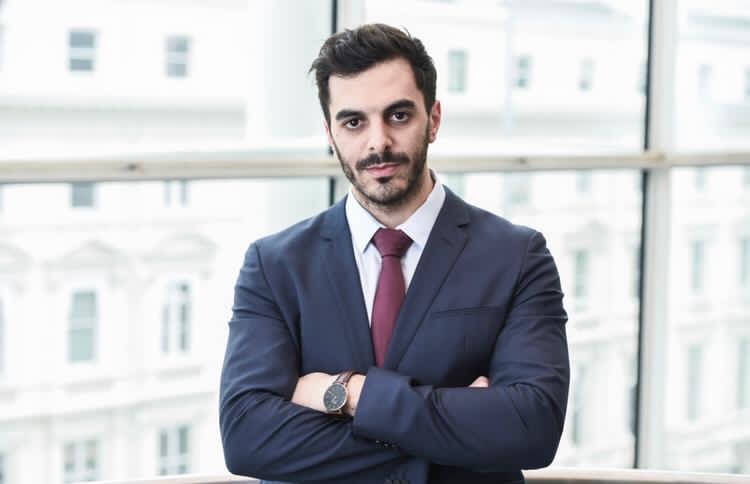
[PART I]
How did you decide to start Wealthyhood?
“A few months ago, together with Kostas Faliagkas (co-founder & CTO of Wealthyhood), we spotted two main trends. The first one had to do with the largest transfer of wealth in history. In particular, Millennials (everyone born between 1980 and 1996) are about to inherit and control more than $20T of assets, by 2030! This is huge. This came together with the realisation that Millennials don’t believe their states will be able to provide for their pension and that they’ll be solely responsible to fund their retirement through systematic saving and investing (there is a lot of research verifying both these trends).”
The problem was everywhere around us. Our friends always asked, “How can I invest my money? I don’t want or know how to actively trade…”.
But how will they do that? Traditional institutions, like banks, wealth managers, etc, are far from ready to accommodate the needs of younger investors. At the same time, digital disruptors were placing all their focus on the day traders or the investors who wanted to leave their money to someone else to manage, with no participation and high fees.
There was a gap there and we decided to start Wealthyhood to bridge this gap. From just giving friendly advice, we built a product that would address this problem: how easily can a young inexperienced investor create a winning portfolio to grow their wealth. We’re building not just of a new tool, but of a whole new DIY wealth management experience for young investors.
This is how Wealthyhood started.”
How does your company differentiate itself from other competitors, like trading apps on the one side, and Robo-advisors on the other side?
“Well, currently the industry for digital investing is split into two extremes.
On the one extreme, we have the trading apps, like Freetrade and e-Tore in Europe, and Robinhood in the US. Trading apps offer many products, but no guidance, insights or tools on how to create a winning portfolio. They incentivize a gambling mentality, instead of robust investing, which is what Wealthyhood aims to achieve, with a holistic portfolio approach. I would say we differentiate on the following points:
- Wealthyhood allows users to diversify their portfolio across all asset classes, like stocks, government and corporate bonds, gold and real estate.
- It offers optimal allocation templates, with different risk-reward profiles, that users can use as guidance and a starting point.
- Wealthyhood provides visual tools, insights, charts and stats on the expected return, risk and projected growth of the investment so that you know what to expect and how your choices affect the profile of your portfolio.
- We also enable automated rebalancing, dividend reinvesting, monthly top-ups and more such functions, to make the whole investing experience much better.
On the other extreme, we have Robo-advisors, like Nutmeg, Wealthify and Moneyfarm in Europe, and Wealthfront, among others, in the US. Robo-advisors, typically charge very high fees for repetitive tasks, and they do not offer any control or participation in the process. So, compared to these players, we offer a lower-cost alternative, while enabling a hands-on, DIY and guided approach:
- Wealthyhood is commission-free and we charge no annual fees. We don’t charge a % on the portfolio’s value every year, so our users’ money can grow more with no fees. That makes a really big difference over time.
- Wealthyhood is personalised. Users can customise their portfolio and participate in the process for a personalised experience. We provide a template allocation to help them as a starting point, but they can customise it and rebalance any time.
- Users have full control and transparency through their investment journey.”

What would you advise anyone willing to start investing without having extensive experience?
“You can google “top investing tips” and you’ll get dozens of different opinions, but in my view, the following 10 things are a must for beginner investors:
- Acknowledge the need to invest and decide your goal. This comes even before you start investing. The first step is to actually understand why you need to be invested and not just keep your savings at your bank. This will help you set realistic goals and manage your emotions during the process.
- Educate yourself. Investing needs experience and experience comes only with time. But before you get there, you can read. So, educate yourself with as much material as possible.
- Start investing as early as possible. You’ll then have more time to correct your mistakes and find what works for you. Also, more time to grow your wealth.
- Understand the power of compounding returns. One of the most fundamental parts of investing.
- Invest in the long run. This does not necessarily mean picking assets with long-term value. Instead, always keep in mind that your goal is to create wealth in the next 10 or 20 years, not next year or the year after. Think like an investor and not as a trader.
- Learn how to budget. To invest more money, you need to save more and knowing how to budget is key for that.
- Invest periodically. Markets go up and down. If you invest your whole sum at one go, then you may find yourself at a peak. Don’t try to time the market! Instead, enter the market at different price levels.
- Make a plan. It has to be diversified and low-cost, as even a 1% fee adds up quickly over time and compounds.
- Stick to the plan. A plan makes no difference if you don’t stick to it. Don’t panic. Ups and downs are expected. Revise your plan but stick to its principles!
- Don’t trade frequently. Don’t trade off emotions. Remember you are an investor and not a trader.”
What criteria do you have in mind to decide in which assets to invest?
I would pick the 4 criteria below:
- Risk/reward profile. Before anything else, it is really important to assess the risk/reward profile of a potential investment. There is no free lunch, so in most cases, the larger upside comes with a larger potential downside. Obviously, this depends on the preferences and the profile of the individual investor, so one should only select assets that are in line with their risk/reward profile.
- Relevance to the economic cycle. Some investments are more suitable for particular phases of the economic cycle. For example, banks, tech stocks, sovereign bonds and pro-cyclical assets are better performing during the expansionary phase. Defensive assets and safe havens like gold and government bonds perform better during deflationary phases. This also affects the selection of the risk/reward profile of the assets.
- Correlation. I always view my portfolio holistically. Not just a set of individually selected securities. And this is what many apps are missing today. So, before the addition of any asset in my portfolio, I check out its relationship with the rest. Analysing and picking a few stocks is good, but ending up with highly concentrated exposure to the US stock market is very risky for a portfolio. Diversification should be broad, on different asset classes, geographies and styles.
- Price moves and news. Although timing the market is not the best thing to do in the long run, a few main principles should be kept in mind. For example, you don’t need to buy airline stocks at the beginning of the Covid-19 crisis, unless you believe their price is at a huge discount. Don’t buy something that is extremely expensive or just because it has gone up by 200%, over the last months.”
What are the biggest challenges your industry will face in the next 5 years?
“Although this is a huge discussion, I would say that the major challenge the industry and the economies, in general, will face in the next 5 years arises from the normalisation of the interest rates and the Quantitative Easing programs.
Following the financial crisis of 2007-2009 that afterwards expanded to Europe, Central Banks had two main weapons to weather the storm:
- lowering interest rates to affect the short end of the interest rates curve
- launching quantitative easing programs, to buy government and corporate bonds, directly from the markets, to affect the long end of the curve.
Due to the unprecedented shock to the economy, Central Banks took these weapons to the extreme, with near-zero or even lower interest rates and repeating QE injections of trillions of dollars. As expected, after a while markets started growing again, firstly in the US and then in Europe – a run that lasted for many years fueled by abundant cheap money, just until Covid-19 came. Any signal of hiking interest rates or decreasing QE was always followed by a sharp drop in the markets. This approach kept going, so, when Covid hit, there was no option other than going even deeper on fiscal and monetary stimulus.
However, this is not a normal state for the markets. Interest rates seem to be “trapped” to near 0, but still, inflation is absent from most economies. The challenge in the next 5 years would be for inflation to pick up again, while at the same time monetary policies to normalize. These two don’t seem to fit together though, so it’ll be a tough one for policymakers.”
What do you think the impact of a possible negative interest rate environment will be for Wealthyhood and investors?
“I think investors begin to realise that in a near-0 interest rate environment, leaving your money at the bank makes no sense. So, more and more people start looking for alternatives on how to earn a yield on their money and this leads them to invest. It is a trend that sooner or later will further strengthen, as more tools that can accommodate this need become available.
This is the case with Wealthyhood. This super accommodative monetary policy leaves no alternative to getting exposure to the financial markets. And Wealthyhood has this exact focus, to enable inexperienced investors to get started on their investment journey. So, I really believe that’s something positive for us.”
Thank you very much for your time Alexandros.
“Thank you, Savvas for this opportunity and all the best.”
[PART II will be published in December. Stay tuned!]
Make sure to follow our social media accounts for more.
Donate & Support