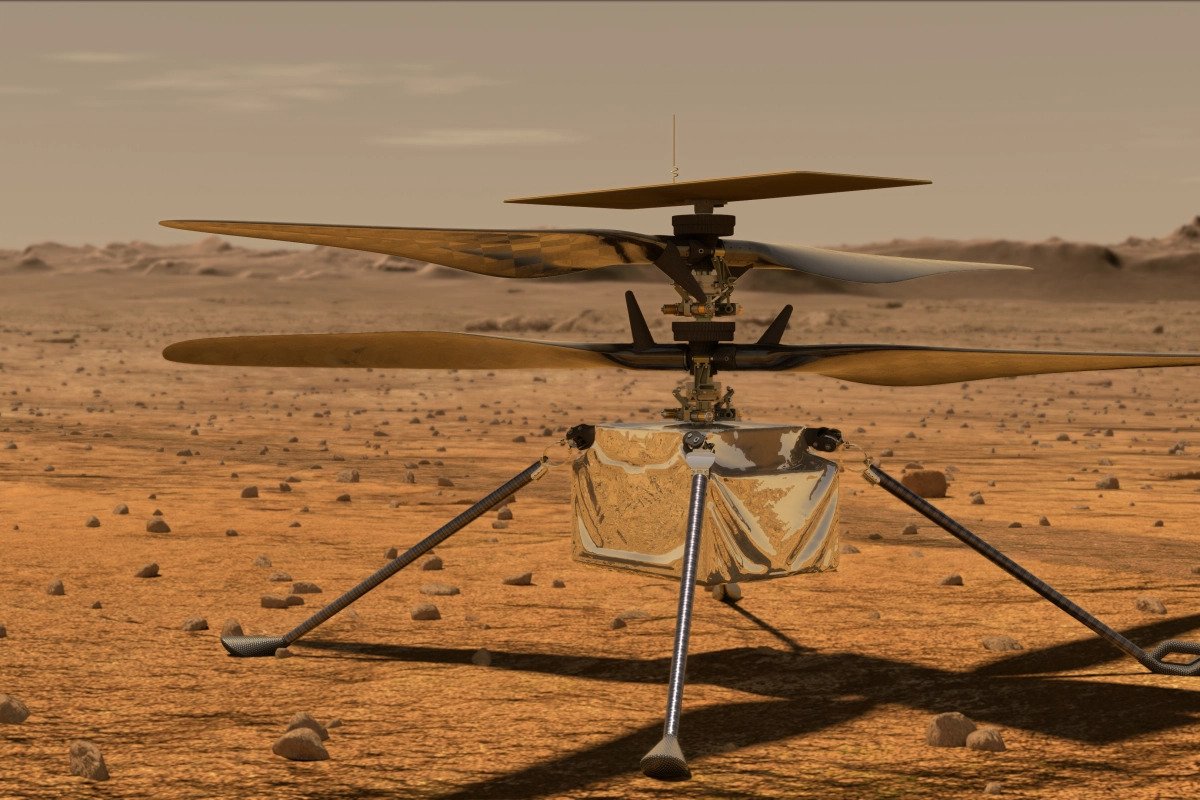
On Tuesday, NASA’s Ingenuity Mars Helicopter completed the first powered controlled flight on another planet. The small helicopter, less than 50 cm tall and weighing less than 2 kg, rose 3m above the surface of Mars, hovered there for about 30 seconds before making a controlled landing back on the surface of Mars.
This was an incredible achievement invoking parallels with the first flight of an aeroplane by the Wright Brothers in 1903, 117 years earlier and 173 million miles away. Like the Wright Brothers’ first flight, which only lasted twelve seconds, the historic significance of Ingenuity’s first flight is not its length or duration, but the demonstration of what can be done.
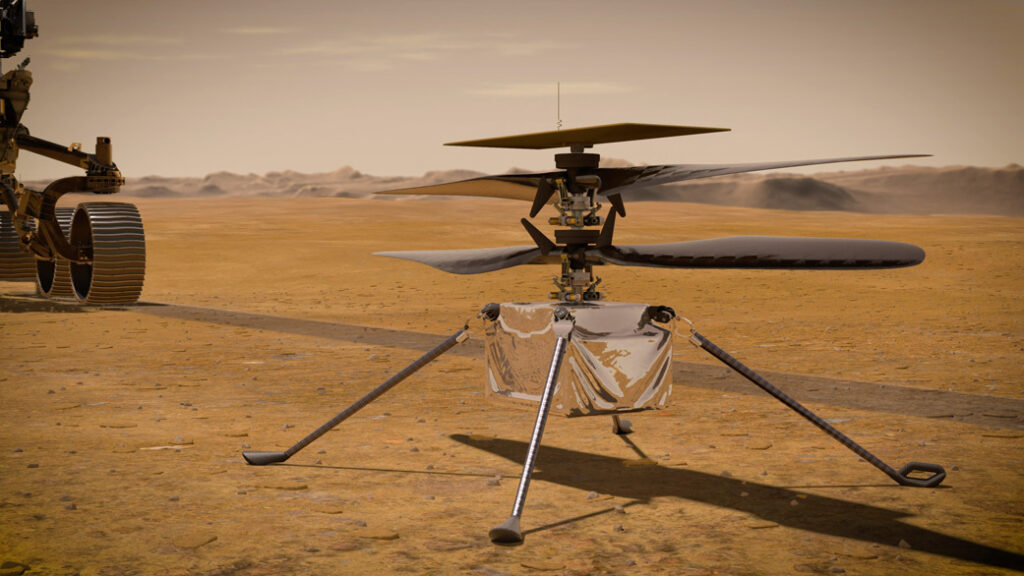
The flight was years in the planning. Early conceptual designs were published by NASA in 2014, engineering models were tested in a simulated Martian atmosphere in 2016 and the flight was approved in 2018 as part of NASA’s Mars 2020 mission. Ingenuity was strapped on the underside of the Perseverance rover drone for the flight to Mars and a 100m drive from the landing site, ready for its first flight on Tuesday, April 19.
There were many technical issues to overcome. Although Mars has only one-third of Earth’s gravity to overcome, it has a much thinner atmosphere with only 1% of Earth’s atmospheric surface atmosphere. This is not much atmosphere for helicopter blades to work with. Ingenuity has two rotary blades, each 1.2 m in diameter that rotates in opposite directions at over 2,500 revolutions per minute, five times what’s needed on Earth.
Not only that, but the flight had to be autonomous. Radio signals to and from Mars take between 5 and 20 minutes each way depending on the relative position of the planets. On April 19th, it was 15 minutes and 27 seconds, meaning the 40-second flight would have been over before any news of liftoff could have reached earth. Given the time-lapse, there is no possibility of flying ingenuity using a real-time joystick on Earth.
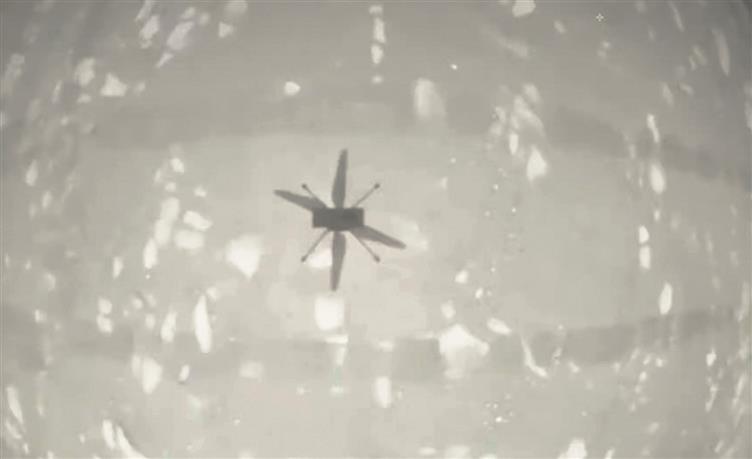
The stage was set for Ingenuity’s first flight at 3:34 a.m. Eastern Standard time, the middle of the day on Mars. Radio commands from NASA’s Mission Control in California were relayed to Ingenuity by the Perseverance Rover strategically parked 200 feet away from the flat terrain that had been selected for the flight. Perseverance was able to capture images 30 times per second to feed into the navigation computer and record the flight. These images, together with images taken from Ingenuity’s camera showing its own shadow over Mars, provide a striking documentary record of the flight.
It was not until three hours later that ground controllers learned that the flight had been successful. They had to wait until NASA’s other Mars Spacecraft, the Mars Reconnaissance Orbiter had passed overhead and was able to relay data and images back to Earth. Only then could celebrations begin and analogies with the Wright Brothers be made.
NASA Associate Administrator for Science, Thomas Zurbuchen, said that “Now, 117 years after the Wright brothers succeeded in making the first flight on our planet, NASA’s Ingenuity helicopter has succeeded in performing this amazing feat on another world”, adding that this area of flat terrain on Mars, “the first of many airfields on other worlds will now be known as Wright Brothers Field”.

There is even a small piece of muslin, the size of a postage stamp taken from the wing of Flyer 1, the Wright brothers’ historic prototype, onboard Ingenuity, where it will rest in perpetuity.
Looking ahead, Ingenuity is scheduled for up to four more flights with plans to travel as far as 50 m and then return. There is no testing equipment on board Ingenuity. The flights are tests in themselves, showing that it is possible to fly on Mars and to envisage the possibility of aerial exploration of Mars to open up new vistas.
As acting NASA administrator, Steve Jurczyk, stated, “We don’t know exactly where Ingenuity will lead us, but today’s results indicate the sky – at least on Mars – may not be the limit”.
To keep up with the latest commercial news, click on commercial to get your daily dose.
Donate & Support