According to Forbes, as of the 31st March 2021, Jeff Bezos is worth a colossal $181.5B making him the wealthiest person on earth. It is worth wondering just how exactly did Bezos amass his fortune? Strategy, innovation, and, unfortunately, exploitation have all played a part in the entrepreneur’s success story.
Bezos pre-Amazon: a brief timeline
The origin of Bezos’ success story begins at Princeton University, where the future billionaire obtained Bachelor of Science degrees in electrical engineering and computer science. He graduated from Phi Beta Kappa in 1986.
After Princeton, Bezos went on to work for Fitel, a telecommunications start-up. Bezos was offered jobs at established companies Intel, Bell Labs, and Anderson Consulting but opted for the start-up. Two years later, the start-up failed, and Bezos took a job as a product manager at Banker’s Trust, which is now part of Deutsche Bank. It is reported that Bezos became the V.P. after only two years at Banker’s trust, but he grew bored and his interest in tech was beginning to take shape.
His penultimate job was at then two-year-old hedge fund D.E. Shaw. True to character, Bezos became V.P after only four years at D.E. Shaw. His responsibilities included researching new business opportunities on the rapidly growing Internet, which was held as having tremendous potential in the early 1990s.

Bezos, keen to participate in the growing internet phenomenon created a list of 20 products he could sell online before concluding that books were the most viable option. He floated the idea to D.E. Shaw who was not on board. Bezos decided to leave the hedge fund to create the company out of his garage.
Speaking on his decision to leave Wall Street in the middle of the year and to start what is now the world’s most prolific online retailer, Bezos said “I knew that I might sincerely regret not having participated in this thing called the internet that I thought was going to be a revolutionizing event. When I thought about it that way… it was incredibly easy to make the decision.”
Thus in 1994 Amazon was born and his risk paid off.
From books to everything else:
Bezos selected Seattle because technical talent Microsoft was located there. In 1997, the company went public. It began selling music and videos in 1998, at which time it also began operations internationally by acquiring online sellers of books in the United Kingdom and Germany. The following year, the company branched out and began selling goods like video games, electronics, and home improvement items.
Although Amazon has been seen to be innovative at many points throughout the company’s 27-year history, what was perhaps the turning point for the company was the use of data in 2002. In 2002, Amazon launched Amazon Web Services (AWS). AWS provided data on website popularity, Internet traffic patterns, and other statistics for marketers and developers. Then, in 2006, Amazon grew its AWS portfolio when Elastic Compute Cloud (EC2), which rents computer processing power as well as Simple Storage Service (S3), which rents data storage via the Internet, were made available. That same year, Amazon started Fulfillment by Amazon which managed the inventory of individuals and small companies selling their belongings through the company internet site.
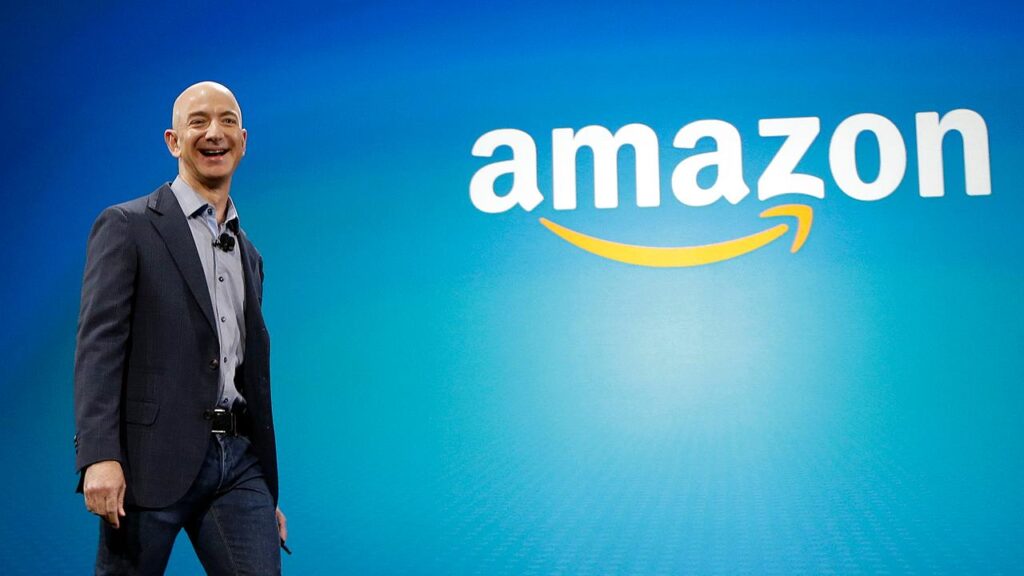
Today, Amazon has a range of products and services ranging from media (books, DVDs, CD) to beauty products and gourmet food. Amazon Web Service alone boasts 200 different products and services. Describing itself as the “world’s most comprehensive and broadly adopted cloud platform”. A far cry from its humble origins.
Amazon and the Pandemic: a controversial win
A second, significant milestone in the company’s success was the coronavirus pandemic. Throughout 2020, the company was able to leverage its position as a household name to establish itself as the largest online retailer in the world. In May of 2020 e-commerce sales nearly doubled. The company currently has 38% of the world’s e-commerce market, followed by Walmart which accounts for 6%.
The cause of Amazon’s success, however, has been at the cost of others. Many workers have reported poor working conditions and little social distancing in the warehouses. Amazon is also facing antitrust charges by the EU who has accused the tech giant of using business data to gain an unfair advantage over merchants operating on its platform. Although this has been a two-year ongoing investigation, the pandemic has played a part in securing a case against the tech company. According to one seller, Amazon notified sellers that during the pandemic, its warehouses would accept only household staples, medical supplies, and “other high-demand products” but it failed to explain how it determined what it would accept. The seller in question has a knitting business and stated that while some sizes of her knitting needles were accepted, others were rejected on grounds of lack of essentiality.
What’s more is that the company is vertically integrated, which further strengthens its monopoly. Much like Tesla has sought to develop and manufacture its chips, Amazon has its delivery, shipment, and packing services. These services meant that not only is the company vertically integrated, but it serves as an essential infrastructure to a host of other businesses.
Amazon’s actions during the pandemic have served to cement itself as the brand it is today and in turn made Jeff Bezos the richest person in the world. Amongst other legal controversies, the tech mogul’s cutthroat management style has also been called into question as employees reveal some of the more drastic actions the former CEO has taken to ensure maximum productivity.
To keep up with the latest commercial news, click on commercial to get your daily dose.
Donate & Support